How VCapDL is Different from yt-dlp and Other Video Downloaders
Most video downloaders such as 4K Video Downloader, yt-dlp, and similar tools are built on a scraper-based approach. They take a video URL as input, parse the webpage, and try to extract the direct media file.
This approach may work, but it is complex and fragile. Modern tools need to support thousands of websites, and each site requires a custom parser. Since websites change frequently, maintaining hundreds or thousands of parsers becomes difficult and time-consuming.
The yt-dlp Approach: Site Parsing
Tools based on yt-dlp rely on scraping website structures. They analyze the page HTML and extract media links using site-specific logic.
While this method supports many platforms, it requires constant maintenance and frequent updates whenever websites change their structure.
VCapDL Approach: Protocol-Based Downloading
VCapDL uses a different strategy. Instead of relying on large-scale website parsing, it supports only a few major platforms such as Facebook, Instagram, TikTok, Vimeo, etc directly.
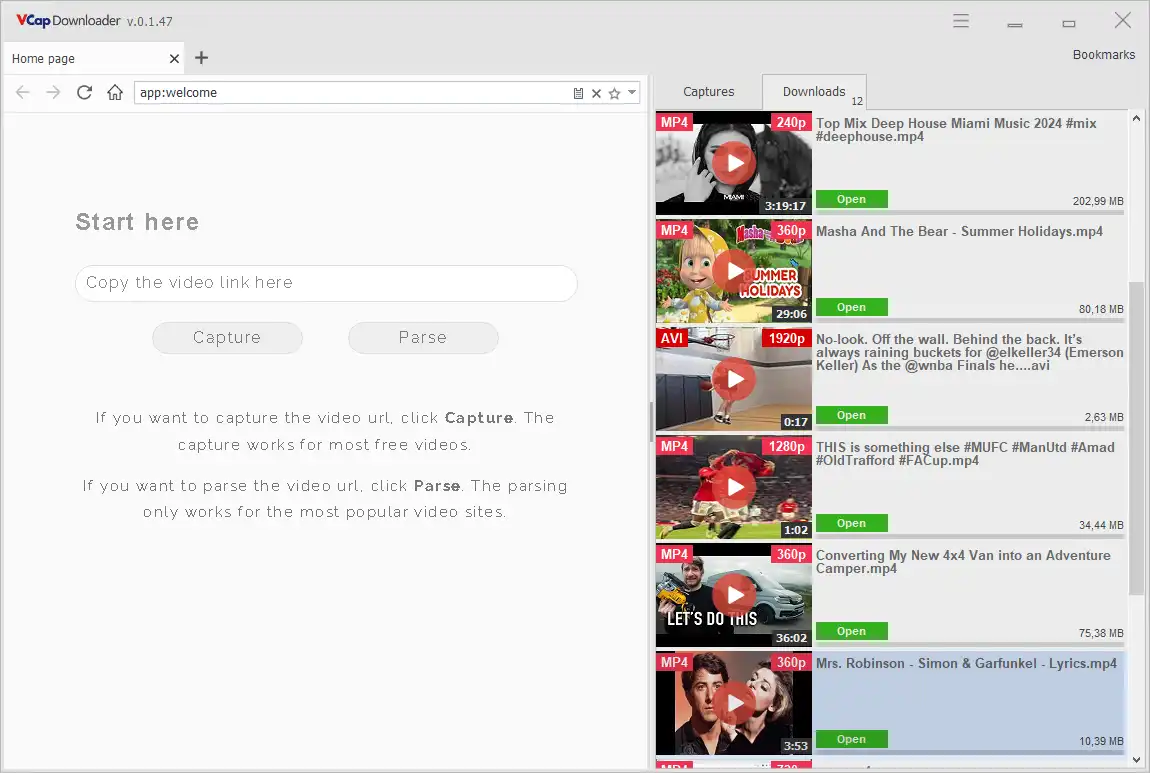
For all other websites, VCapDL uses a built-in browser based on the CEF (Chromium Embedded Framework) engine. This allows the application to observe network traffic directly.
VCapDL works with modern video streaming protocols such as HLS and MPEG-DASH. Instead of parsing HTML pages, it captures streaming manifests and extracts ready-to-use media URLs directly from the network layer.
Why This Matters
This architecture allows VCapDL to support millions of websites without needing individual parsers for each one. Instead of maintaining fragile site-specific scraping logic, VCapDL relies on standardized video streaming protocols.
The result is a more scalable, stable, and future-proof downloading engine.
Learn More
- How VCapDL Works
- VCapDL's Features
- Video Downloader
- HLS (M3U8) Downloader
- HPEG-DASH (MPD) Downloader
- Video to MP3 Converter
- Streaming Video Downloaders Explained